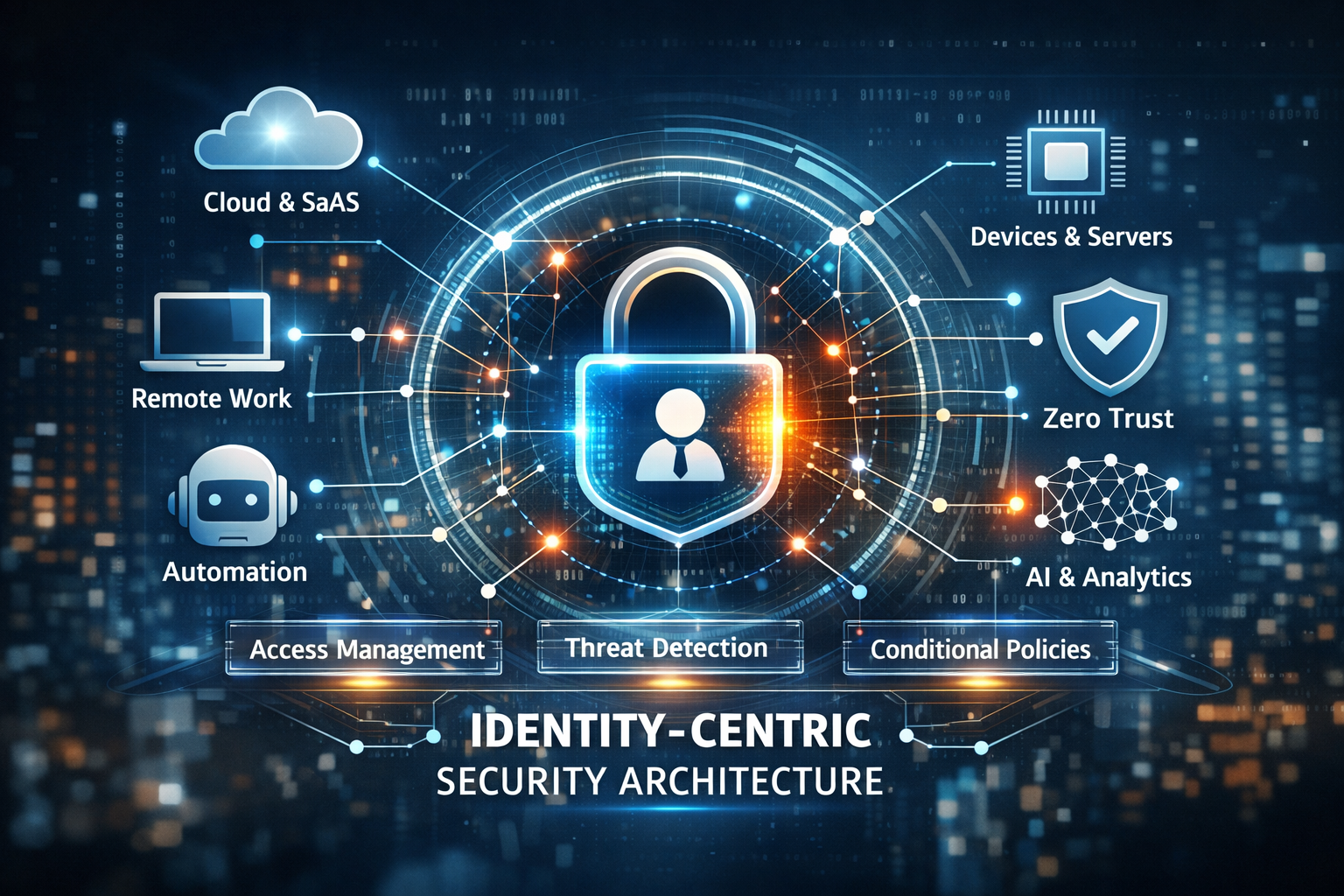
Identity-centric security architecture has become the defining characteristic of modern security strategy. As organizations expand across cloud platforms, SaaS applications, remote workforces, and automated systems, traditional security models no longer scale. Instead, access decisions, trust evaluation, and enforcement increasingly depend on identity context.
Rather than operating as a supporting function, identity now shapes how security decisions are made across environments.
How Identity-Centric Security Architecture Emerged
This shift did not occur overnight, and it did not come from a single technology decision.
Instead, environmental change forced security models to adapt.
Applications moved to SaaS, dissolving network boundaries.
Users began working from unpredictable locations.
Organizations adopted short-lived and unmanaged devices.
Automation expanded rapidly across IT and security workflows.
Service accounts and machine identities multiplied quietly.
At the same time, attackers adapted their techniques.
Rather than breaking infrastructure, they abused trust relationships.
Instead of exploiting systems, they leveraged legitimate access paths.
Credential theft.
Token replay.
OAuth abuse.
Consent manipulation.
These methods succeed because they resemble normal activity. Over time, access itself became the most reliable attack surface.
Where Identity-Driven Security Decisions Actually Happen
Modern security decisions rarely depend on a single alert or control.
Instead, teams evaluate layered context:
- Who or what initiates a request
- What resource the request targets
- Where the activity originates
- How risky the behavior appears
- What historical patterns exist
Identity-centric security architecture brings these signals together.
Security teams authorize activity based on context rather than assumptions.
They evaluate risk dynamically instead of relying on static rules.
They enforce controls continuously as conditions change.
Whether a human user, automated workflow, workload, or service account initiates activity, security teams reassess trust continuously.
Architectural Impact of an Identity-First Security Model
When organizations treat access as static, security becomes fragile.
When they adopt an identity-first model, security becomes adaptive.
An identity-centric security architecture enables teams to:
- Evaluate access continuously rather than once per session
- Adjust enforcement based on behavior instead of location
- Correlate activity across systems using shared identity context
- Reduce reliance on network-based trust assumptions
This approach also reshapes how other controls operate.
Endpoints, cloud workloads, data protection platforms, and monitoring systems no longer operate in isolation. Instead, they act as enforcement points connected through identity context.
As a result, security controls function as a coordinated system rather than disconnected layers.
This architectural shift directly shapes how security teams design detection and monitoring, because platforms like Microsoft Sentinel depend on identity context to correlate signals, reduce noise, and drive meaningful security operations.
Why Many Security Programs Still Struggle with Identity Architecture
Despite its importance, many organizations still isolate identity from core security operations.
Common challenges include:
- Governance activities focused primarily on audits
- IAM teams operating separately from SOC teams
- Identity telemetry excluded from detection workflows
- Access reviews performed without real behavioral insight
When identity data remains disconnected, teams lose valuable context.
The impact appears quickly:
- Detections lose precision
- Investigations slow down
- Response decisions feel uncertain
- Automation introduces risk
- AI tools struggle to deliver value
In most cases, tooling is not the problem. Architecture is.
Identity-Centric Security Architecture and AI Readiness
As organizations adopt AI-driven security capabilities, identity context becomes even more critical.
AI systems rely on structured signals to summarize incidents, recognize patterns, and recommend actions. Identity telemetry provides much of that structure.
When identity signals are strong:
- AI prioritizes incidents accurately
- Behavioral explanations become clearer
- Analyst confidence increases
When identity signals remain fragmented:
- AI amplifies uncertainty
- Recommendations feel inconsistent
- Operational gaps become more visible
This is why identity maturity directly influences AI effectiveness in security operations.
For additional context, Microsoft outlines this convergence clearly in its Zero Trust and identity guidance:
What This Means for Security Leaders
Security leaders do not need more tools.
They need to design around identity-centric security architecture.
That means leaders must:
- Center security strategy on trust and access decisions
- Ensure identity telemetry feeds detection and response workflows
- Align IAM, SOC, and cloud teams around shared outcomes
- Evaluate controls through an identity-driven lens
Identity does not replace other controls. It connects them.
As environments continue to scale and automate, this connective role becomes more critical every year.
Final Thought
Identity did not suddenly become important.
Modern security simply cannot function without identity shaping decisions across architecture, operations, and automation.
As organizations rethink security strategy for the year ahead, the real question is whether identity-centric security architecture is guiding those decisions.
Because in modern security, trust begins with identity.
To review previous posts, please click here