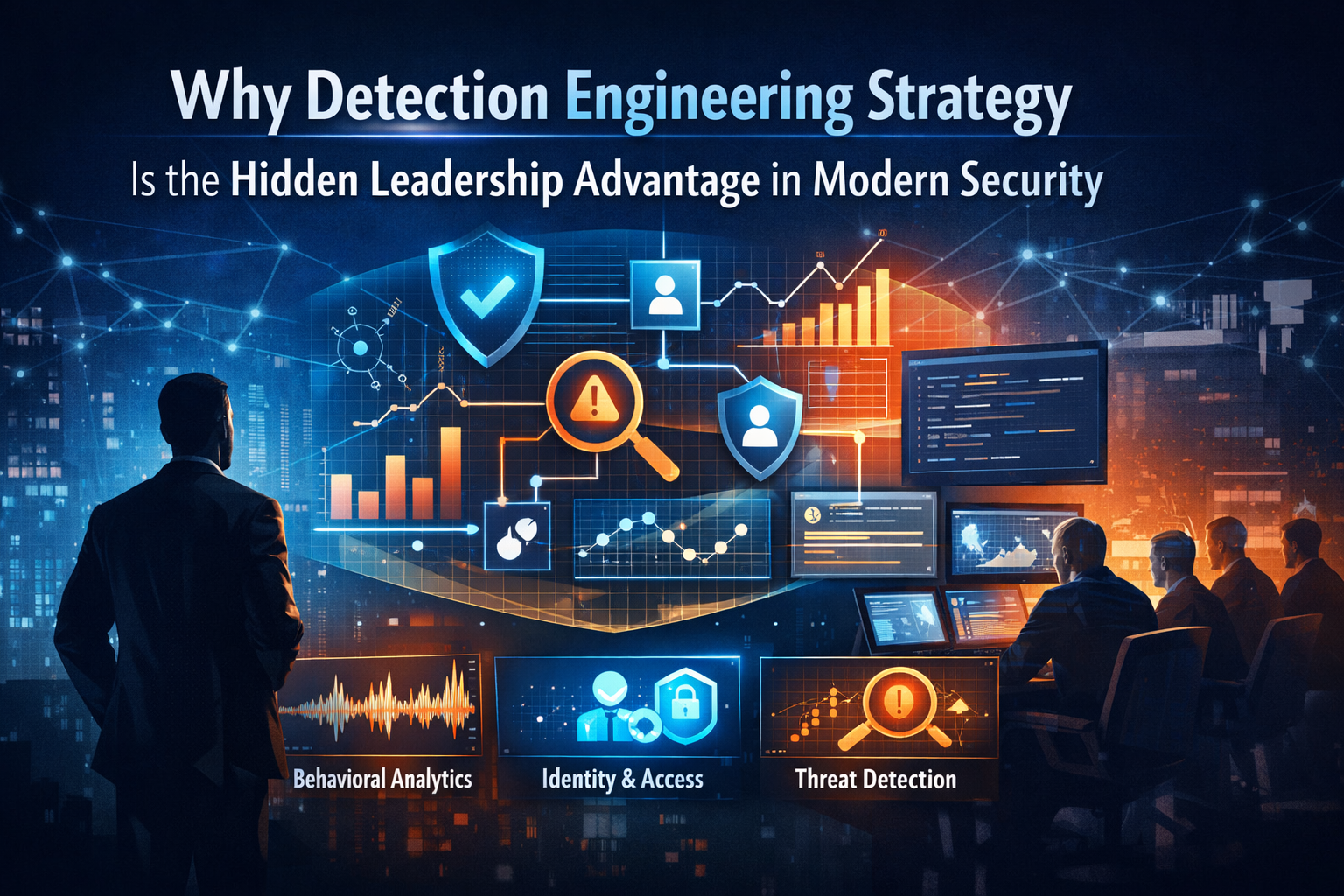
Detection engineering strategy determines whether a security program produces meaningful outcomes or simply generates noise. While many organizations treat detection writing as a technical function inside the SOC, effective detection engineering begins at the leadership level. Architecture decisions, telemetry investment, identity maturity, and measurement models all shape the quality of detections long before an analyst writes a query.
In modern environments, detection quality reflects leadership clarity.
Why Detection Engineering Strategy Often Fails
Many organizations struggle because they approach detection engineering reactively.
First, teams deploy vendor-provided analytics rules without tailoring them to their environment. Next, they measure success by alert volume instead of investigative clarity. Over time, analysts tune rules aggressively to reduce fatigue, which frequently suppresses meaningful visibility.
As a result, detection programs drift toward compliance coverage rather than threat-informed design.
Detection engineering strategy fails when organizations:
- Build rules without behavioral hypotheses
- Ignore identity and contextual enrichment
- Separate telemetry design from detection outcomes
- Measure performance using activity instead of impact
Although the tooling may be modern, the underlying strategy often remains fragmented.
What Effective Detection Engineering Strategy Requires
A mature detection engineering strategy begins with intent.
Rather than asking, “What alerts can we enable?” leaders should ask, “What behaviors matter most in our environment?”
From that perspective, effective programs focus on:
- Hypothesis-driven detection design
- Behavioral analytics instead of signature-only logic
- Identity enrichment and entity mapping
- Continuous tuning based on investigative feedback
Because modern attacks frequently abuse legitimate access, detections must correlate signals across identity, endpoint, cloud, and data layers.
In other words, detection engineering must operate as an architectural discipline, not just a scripting exercise.

The Leadership Role in Detection Quality
Detection engineering strategy reflects leadership priorities.
Budget decisions influence telemetry coverage.
Architectural choices affect signal clarity.
Metrics drive analyst behavior.
Operational incentives shape tuning practices.
If leadership rewards alert quantity, teams optimize for volume. Conversely, when leadership measures detection effectiveness through investigative clarity and risk reduction, programs mature.
Therefore, detection quality is not owned solely by the SOC. Leaders shape the environment that determines whether strong detections are even possible.

Detection Engineering Strategy and Microsoft Sentinel
Modern SIEM platforms support detection engineering, but they do not replace strategic design.
Solutions like Microsoft Sentinel enable organizations to build analytics rules enriched with identity context, behavioral insights, and entity mapping. Sentinel supports custom detections, Fusion correlation, and cross-domain signal analysis; however, the effectiveness of these capabilities depends on the surrounding strategy.
When organizations implement a clear detection engineering strategy within Sentinel, they can:
- Design analytics around behavioral hypotheses
- Map entities to improve investigation context
- Correlate signals across Microsoft Defender and Entra
- Continuously refine detections using operational feedback
Microsoft provides guidance on detection design and analytics configuration:
- https://learn.microsoft.com/azure/sentinel/detect-threats-built-in
- https://learn.microsoft.com/azure/sentinel/tutorial-detect-threats-custom
However, strong engineering practices require more than documentation. They require leadership alignment.
Why Detection Engineering Strategy Depends on Identity
Identity-centric architecture directly influences detection effectiveness.
When detections lack identity enrichment, investigations slow down. In contrast, when analytics incorporate identity risk, behavioral baselines, and access patterns, analysts gain immediate clarity.
Because identity frequently acts as the attack surface, detection engineering must integrate:
- Risk-based user evaluation
- Privilege analysis
- Anomalous access detection
- Machine and service account monitoring
Without identity context, detections remain incomplete.
Designing Metrics That Support Detection Engineering Strategy
Measurement determines behavior.
If leaders track:
- Total alerts generated
- Tickets closed per shift
- Time spent triaging
Then teams will optimize for activity.
Instead, detection engineering strategy should emphasize:
- Detection-to-investigation clarity
- Mean time to decision
- False positive reduction over time
- Signal quality improvement
When leaders align metrics with outcomes, detection maturity accelerates.
Preparing Detection Engineering for AI and Automation
As AI becomes more embedded in security platforms, detection engineering strategy grows even more important.
AI systems rely on structured, high-quality detections. Poorly designed analytics create noisy inputs that confuse both machines and humans. Conversely, well-structured detections enhance AI-assisted triage and incident summarization.
Therefore, organizations that invest in thoughtful detection engineering position themselves to benefit from automation and AI rather than amplify operational gaps.
What This Means for Security Leaders
Security leaders should treat detection engineering strategy as a core architectural responsibility.
That means:
- Defining behavioral priorities before enabling rules
- Investing in identity and telemetry quality
- Aligning SOC, IAM, and cloud teams
- Measuring detection effectiveness instead of activity
Detection engineering does not succeed by accident. Leaders design environments where strong detections can emerge.
Final Thought
Technology enables detection engineering.
Strategy determines whether it works.
As organizations mature their security operating models, leaders must recognize that detection engineering strategy sits at the intersection of architecture, operations, and identity.
When leaders own that responsibility, detection quality improves. When they delegate it entirely, noise returns.
If you want to review previous posts, please go here