The start of a new year always brings noise.
Predictions follow quickly. Trend lists appear everywhere. Bold claims about what will change everything are suddenly unavoidable. Most of it sounds familiar because, frankly, most of it is.
Still, every once in a while, a year feels different. Not because of a single product launch or headline announcement, but because the direction becomes hard to ignore.
This post is not a recap of announcements. Instead, it is a reflection on what those announcements reveal about where security leadership must go next.
After digesting the themes coming out of Microsoft Ignite, one thing stood out to me: security is not just evolving anymore. It is converging.
After more than 25 years in cybersecurity, I have watched the industry move through perimeter security, compliance driven programs, and repeated waves of tool sprawl. Over time, very few moments truly forced security leaders to rethink how security is designed and operated. This year feels like one of those moments.
Because of that shift, security leaders must think differently going into this year.
This Year Isn’t About New Tools
Most organizations already own more security tools than they actively use. At this point, that is not a controversial statement. It is simply reality.
What Ignite reinforced, without always saying it out loud, is that the real challenge is not capability. Instead, it is cohesion.
For years, security programs grew sideways. Another product appeared here. Another dashboard showed up there. Eventually, another alert stream demanded someone’s attention. While that approach worked when environments were smaller and threats were noisier, it no longer holds up.
Today, it does not work anymore.
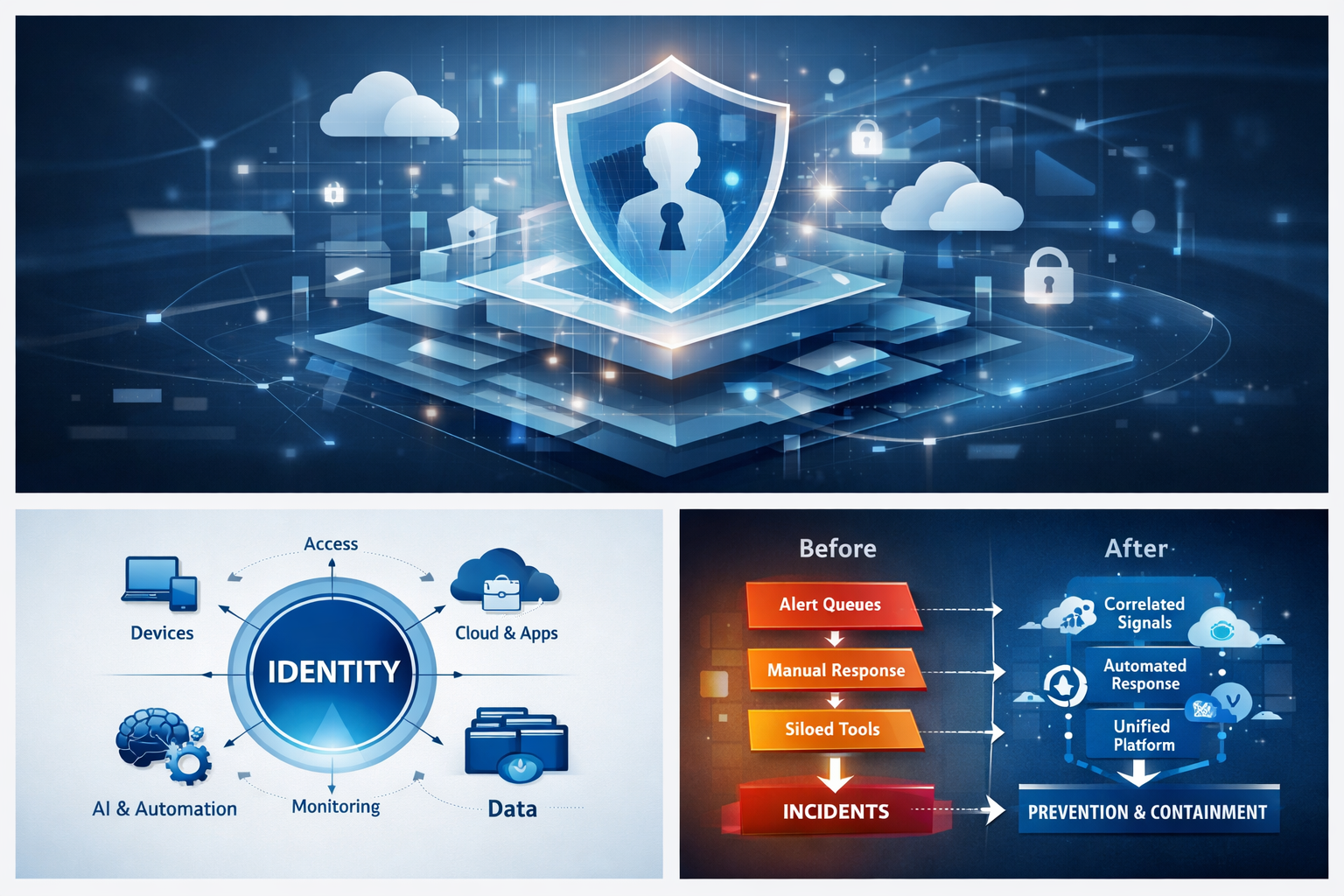
Instead, the shift we are seeing is away from individual tools and toward security as a system. In practice, signals matter more than features. Likewise, outcomes matter more than alert volume.
As a result, if you are still thinking in isolated products, you are already behind.
Identity Isn’t a Component Anymore. It Is the Foundation.
If there is one area security leaders cannot afford to treat as someone else’s problem this year, it is identity.
Attackers figured this out a while ago. Stolen credentials, token abuse, and OAuth misuse are no longer edge cases. Instead, they have become standard operating procedure.
What has changed, however, is how clearly identity now sits at the center of everything:
- Access decisions
- Risk evaluation
- Detection context
- Enforcement
Whether it is a user, a workload, or an automated process, identity is where trust is granted or revoked.
Because of this, security strategies that still treat identity as just IAM will struggle. In contrast, the ones that treat it as the control plane will scale.
The SOC Model Is Quietly Being Rewritten
Another thing that became clear is that the traditional idea of a SOC, as a place, a room, or a queue of alerts, does not really hold up anymore.
Today, the modern SOC is not defined by headcount or ticket volume. Instead, it is defined by:
- How quickly teams understand what is happening
- How confidently they can act
- How often they do not have to act at all
As expectations shift, modern SOC platforms are not just changing tooling. They are changing how success is measured.
Because of that, if your SOC is still measured by how many alerts it processes rather than how many incidents it prevents or contains early, it is time to rethink the model.
AI Won’t Fix a Messy Security Program
There is no avoiding AI this year. It is everywhere in security conversations, and understandably so.
However, here is the uncomfortable truth.
AI does not clean up messy foundations. Instead, it exposes them.
In environments where detections are noisy, AI often accelerates confusion rather than clarity.
Likewise, weak identity governance causes AI systems to surface risk faster and more visibly.
Meanwhile, manual response processes become even more exposed as AI highlights just how slow they really are.
On the other hand, teams that have already invested in clean signals, consistent architecture, and intentional workflows will see real gains.
Ultimately, AI is a multiplier. What it multiplies depends entirely on what you have already built.
The Real Leadership Shift Happening This Year
The biggest change this year is not technical. Instead, it is personal.
Security leaders are moving away from being tool owners and toward being system designers.
That shift means spending less time comparing feature checklists and more time asking:
- How do signals flow through our environment
- Where do decisions actually happen
- Which controls truly change outcomes, not just scores
Because modern security platforms now reward architectural thinking, this transition is unavoidable. At the same time, it exposes leaders who are not ready to make that shift.
What This Blog Will Focus On Going Forward
This first post is not about announcements. Rather, it is about mindset.
Over the coming months, this blog will focus on the practical side of that shift:
- Detection quality over alert volume
- Identity centric security design
- Modern SOC automation that actually reduces load
- Where AI helps and where it does not
- Turning Microsoft Security strategy into operational maturity
Ultimately, the goal is not to chase what is new. It is to understand what actually works.
Final Thought
The new year does not require a new strategy as much as it requires clarity.
The security teams that succeed this year will not be the ones reacting faster to noise. Instead, they will be the ones who designed systems that reduce noise in the first place.
Experience teaches that moments like this do not come often. Because of that, the work starts now.
The real question is not whether security will change this year, but whether our thinking will change with it.
To review previous posts, please click here