By Mike D. Taylor
In our previous post, Critical Sentinel Shift Security Leaders Can’t Ignore, we discussed why the transition of Microsoft Sentinel into the Microsoft Defender portal represents far more than a simple user interface change.
While many organizations are focused on the technical aspects of the transition, the larger challenge often lies elsewhere. The most significant risks aren’t typically related to data collection, analytics rules, or workspaces. Instead, they emerge when organizations underestimate the operational impact of changing how their Security Operations Center functions.
The good news is that these risks can be identified and addressed early. However, organizations first need to understand where those challenges are most likely to appear.

Risk #1: Analysts Continue Working Like Nothing Changed
One of the most common mistakes organizations make is assuming that analyst workflows will naturally evolve alongside the platform.
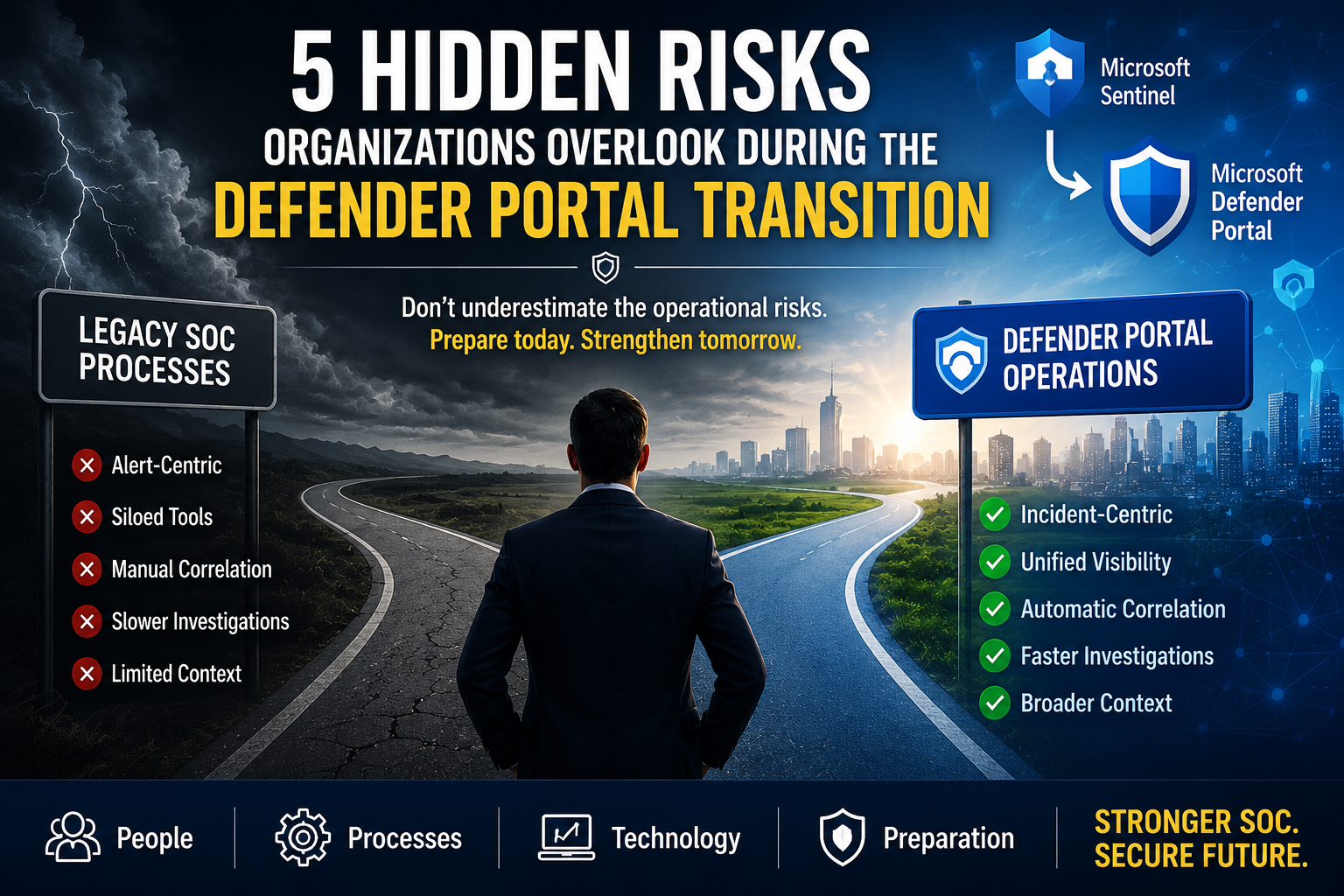
Historically, many SOC teams have operated using an alert-centric approach. Analysts receive alerts, investigate individual findings, and determine whether escalation is necessary.
The Defender portal introduces a fundamentally different model.
Instead of starting with alerts, analysts begin with incidents that automatically correlate activity across multiple security domains. This provides a broader attack narrative and reduces the need for manual correlation.
However, if analysts continue investigating individual alerts as they always have, organizations may experience:
- Longer investigation times
- Missed attack relationships
- Reduced efficiency
- Inconsistent triage practices
Technology can enable better workflows, but only if teams adopt them.

Risk #2: Automation Dependencies Are Poorly Understood
Many organizations have spent years developing automation around Sentinel.
Those automations often include:
- Playbooks
- Logic Apps
- Ticketing integrations
- Notification workflows
- Escalation procedures
- Custom incident enrichment
While most automations will continue to function, organizations should not assume every workflow behaves exactly as expected after operational processes shift.
Questions security teams should be asking include:
- Which automations are triggered by alerts versus incidents?
- Are ITSM integrations dependent on specific workflows?
- Are incident ownership processes still valid?
- Do enrichment processes align with the new investigation experience?
Understanding these dependencies before they become operational issues significantly reduces risk.
Risk #3: Training Happens Too Late
One of the biggest misconceptions surrounding this transition is that analysts can simply learn the Defender portal when the time comes.
Unfortunately, operational habits are difficult to change under pressure.
Analysts should become familiar with:
- Unified incident investigations
- Cross-domain threat correlation
- Defender XDR investigation experiences
- Entity relationships
- New navigation patterns
- Updated hunting workflows
Organizations that delay training often discover that adoption becomes slower and more disruptive than anticipated.
By contrast, organizations that introduce the Defender portal gradually allow analysts to build confidence before the transition becomes mandatory.
Risk #4: Existing Processes and Runbooks Become Outdated
Most mature SOCs maintain extensive documentation supporting security operations.
This often includes:
- Incident response procedures
- Escalation workflows
- Analyst playbooks
- Investigation guides
- Training materials
- Audit documentation
Many of these documents reference Azure portal workflows directly.
As organizations transition to the Defender portal, these references may become inaccurate or obsolete.
Failing to update documentation can create:
- Analyst confusion
- Process inconsistencies
- Delayed investigations
- Audit and compliance concerns
The portal may change quickly. Operational documentation rarely does.
This makes proactive review and modernization essential.
Risk #5: Waiting Until the Deadline Approaches
Perhaps the most significant risk is simply waiting too long.
Microsoft has communicated that after March 31, 2027, Sentinel will no longer be supported through the Azure portal.
For some organizations, that may feel distant.
However, successful operational transitions typically require:
- Workflow validation
- Analyst training
- Process refinement
- Automation testing
- Governance updates
- Executive alignment
Organizations that begin preparing now have the advantage of making thoughtful adjustments over time.
Organizations that wait may be forced into reactive decision-making under tighter deadlines.
How to Reduce Transition Risk
The most successful organizations typically approach this transition in phases rather than treating it as a single migration event.

Phase 1: Evaluate
Begin by understanding how your current SOC operates.
Assess:
- Analyst workflows
- Incident handling processes
- Existing automations
- Integration dependencies
The goal is to establish a baseline.
Phase 2: Pilot
Select a small group of analysts to begin operating within the Defender portal.
During this phase:
- Validate investigation workflows
- Identify friction points
- Compare experiences
- Document lessons learned
This creates valuable feedback before broader adoption.
Phase 3: Optimize
Use insights from the pilot to refine operations.
Focus on:
- Updating runbooks
- Revising escalation procedures
- Validating automation
- Improving analyst guidance
This phase transforms lessons learned into repeatable processes.
Phase 4: Operationalize
Once workflows have been validated, organizations can begin broader adoption.
At this stage:
- Establish governance
- Measure adoption metrics
- Monitor analyst effectiveness
- Continuously improve processes
The goal is not simply to move to a new portal.
The goal is to improve security operations.
Why Security Leaders Should Act Now
The organizations that gain the most value from this transition will not necessarily be the ones that migrate first.
They will be the organizations that prepare most intentionally.
By evaluating workflows, validating automation, updating documentation, and investing in analyst readiness today, security leaders can significantly reduce disruption tomorrow.
More importantly, they position their SOC to take advantage of the broader vision Microsoft is building around unified security operations.
Start Evaluating Your Environment
Organizations looking to assess their readiness can begin with Microsoft’s official guidance:
- Transition Your Microsoft Sentinel Environment to the Defender Portal
- Microsoft Sentinel in the Microsoft Defender Portal Overview
- Connect Microsoft Sentinel to the Microsoft Defender Portal
Organizations that begin validating workflows early will reduce operational risk later.
What Comes Next
In our next article, we’ll move beyond risk management and focus on the future-state operating model.
We’ll explore what a modern Defender Portal-centric SOC looks like, how analyst workflows evolve, where automation should be focused, and how security leaders can position their teams for long-term success.
Because the real opportunity isn’t simply migrating to a new portal.
It’s building the next generation of security operations.
To review last week’s post, click here
To review any previous post, click here