By Mike Taylor
In our previous articles, we explored why the transition of Microsoft Sentinel into the Microsoft Defender portal represents far more than a simple user interface change and examined the hidden risks organizations often overlook during the Defender Portal Transition.
However, focusing solely on migration activities misses the bigger opportunity.
The real question security leaders should be asking is:
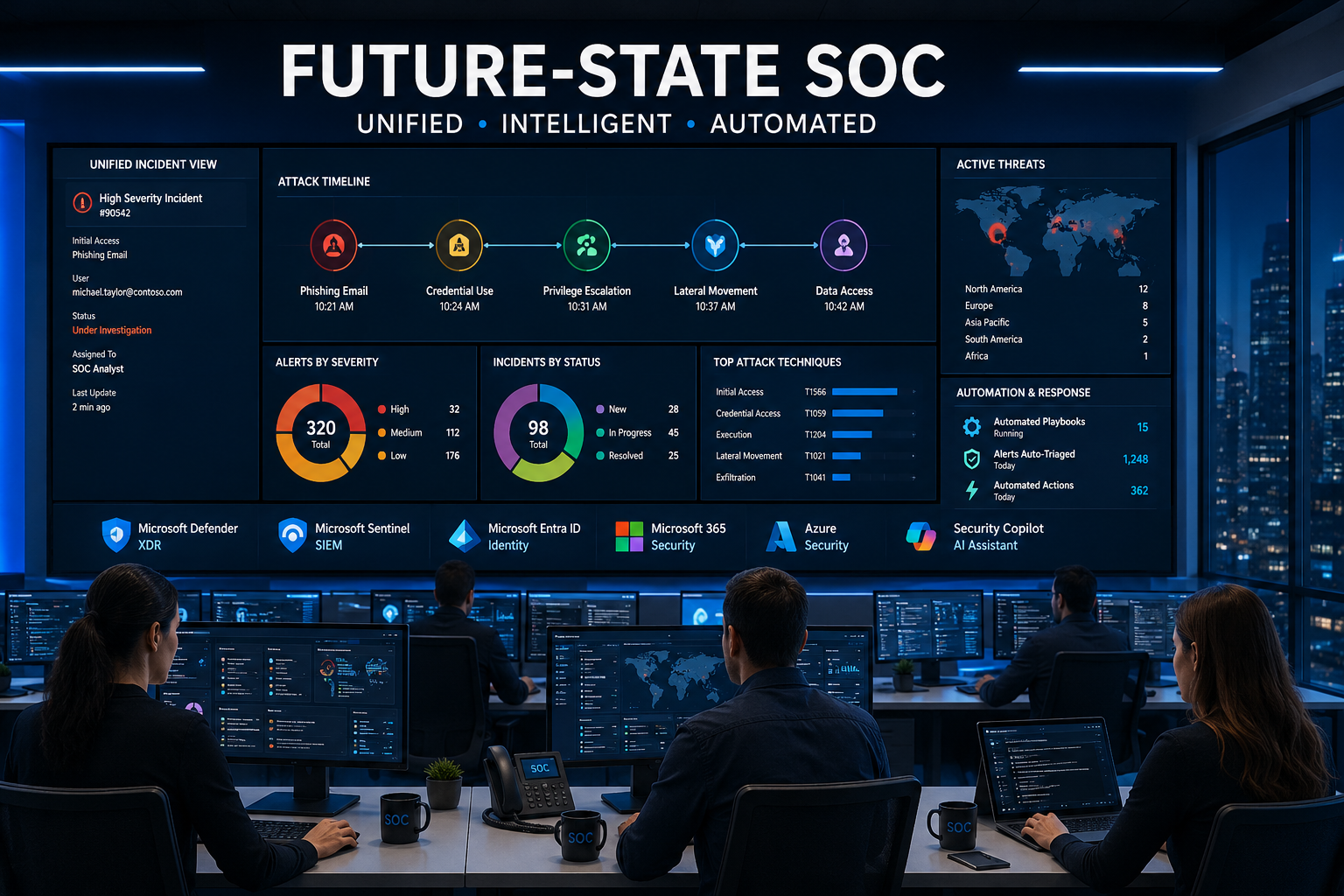
What should a modern Security Operations Center look like once the Defender Portal Transition is complete?
Organizations that approach this transition strategically have an opportunity to modernize operations, improve analyst effectiveness, reduce operational complexity, and build a more unified security operations experience.
The goal isn’t simply to move to a new portal.
The goal is to build the next generation of security operations.
The Traditional SOC Model Is Reaching Its Limits
For years, many Security Operations Centers have operated using a familiar model.
Analysts monitor multiple consoles, investigate individual alerts, manually correlate events, and navigate across different security tools to understand what is happening.
Although these approaches have served organizations well, today’s threat landscape demands something different.
Security teams now defend:
- Identities
- Endpoints
- Cloud applications
- Infrastructure
- Hybrid environments
As attack surfaces continue to expand, analysts need more context—not more alerts.
Unfortunately, many traditional SOC workflows were never designed to support this level of complexity.
As a result, analysts often spend more time gathering information than investigating threats.
Unified Security Operations Becomes the New Standard
One of the most significant opportunities created by the Defender Portal Transition is the ability to move toward unified security operations.
Rather than investigating activity across multiple disconnected tools, analysts can work from a centralized incident experience that brings together signals across multiple security domains.
These domains include:
- Identity
- Endpoint
- Cloud applications
- SIEM telemetry
This unified view fundamentally changes how investigations occur.
Instead of manually piecing together evidence from separate consoles, analysts receive a more complete attack narrative from the start.
As a result, organizations benefit from:
- Improved visibility
- Faster triage
- Better prioritization
- Reduced investigation time
- More consistent analyst experiences

The future-state SOC is no longer centered around individual tools.
It is centered around the incident.
Analysts Become Investigators, Not Alert Processors
One of the most important changes involves the role of the analyst.
Historically, analysts spent significant amounts of time:
- Reviewing alerts
- Gathering context
- Correlating activity
- Escalating incidents
- Documenting findings
While these activities remain important, the future-state SOC shifts analyst focus toward higher-value work.
As correlation improves and investigations become more streamlined, analysts can spend more time:
- Understanding attacker behavior
- Investigating attack progression
- Evaluating business impact
- Making response decisions
- Hunting for threats
This evolution represents a major opportunity for security teams.
Instead of serving primarily as alert processors, analysts become true security investigators.
Organizations that support this transition through training and process improvements often see significant gains in operational efficiency and analyst satisfaction.

Automation Becomes a Force Multiplier
Modern security operations cannot scale through staffing alone.
Alert volumes continue to grow, while skilled security professionals remain difficult to find.
As a result, automation becomes increasingly important.
The most mature SOCs leverage automation to handle repetitive tasks such as:
- Alert enrichment
- Incident assignment
- Ticket creation
- Notification workflows
- Data gathering
- Initial response actions
Automation should not replace analysts.
Instead, it should eliminate low-value activities that consume valuable analyst time.
When implemented correctly, automation acts as a force multiplier that allows security teams to focus on investigation and decision-making rather than administrative work.
Detection Engineering Takes Center Stage
As SOC maturity increases, organizations often discover that the quality of detections matters more than the quantity.
Generating thousands of alerts does not necessarily improve security outcomes.
Generating meaningful detections does.
Future-state SOCs increasingly invest in:
- Detection engineering
- Threat-informed detections
- MITRE ATT&CK mapping
- Detection tuning
- Attack coverage validation
The objective shifts from alert generation to actionable detection.
This approach improves analyst efficiency while reducing noise and alert fatigue.
The result is a security operation focused on identifying meaningful threats rather than processing excessive volumes of low-value alerts.
Security Copilot Accelerates Security Operations
Artificial intelligence is beginning to transform how security teams operate.
Tools such as Microsoft Security Copilot help analysts accelerate investigations by providing contextual insights, summarizing incidents, and assisting with hunting activities.
Potential use cases include:
- Incident summarization
- Investigation guidance
- Threat hunting assistance
- KQL query generation
- Security data interpretation
- Response recommendations
Organizations should view AI as an accelerator rather than a replacement.
The future-state SOC combines:
- Human expertise
- Automation
- AI-assisted workflows
Together, these capabilities create a more efficient and effective security operation.
Metrics That Matter in a Future-State SOC
Traditional SOC metrics often focus on volume.
Examples include:
- Number of alerts
- Number of incidents
- Tickets created
While these metrics may provide operational insight, they do not necessarily measure effectiveness.
Future-state SOCs increasingly focus on outcome-based metrics such as:
- Mean Time to Detect (MTTD)
- Mean Time to Respond (MTTR)
- Investigation efficiency
- Detection quality
- Automation effectiveness
- Incident closure quality
These metrics provide a more accurate picture of SOC performance and help security leaders demonstrate value to the organization.
What Security Leaders Should Do Now
Organizations do not need to wait until the Defender Portal Transition is complete to begin building a future-state SOC.
Security leaders can begin preparing today by:
- Piloting the Defender portal experience
- Evaluating analyst workflows
- Identifying automation opportunities
- Reviewing detection strategies
- Measuring operational effectiveness
- Exploring Security Copilot use cases
Each of these activities helps reduce transition risk while simultaneously improving operational maturity.
Organizations that begin now will be better positioned to take advantage of the capabilities offered by unified security operations.
Start Planning Your Future-State SOC
Organizations looking to modernize security operations can begin by evaluating current workflows and understanding how unified security operations can improve efficiency and visibility.
Recommended areas to assess include:
- Analyst workflows
- Incident response processes
- Detection engineering practices
- Automation opportunities
- Security Copilot readiness
- SOC performance metrics
Additional Microsoft Resources
Organizations looking to accelerate their planning efforts can also review Microsoft’s guidance on unified security operations and modern SOC practices:
- Unified Security Operations Overview
- Microsoft Sentinel in the Microsoft Defender Portal
- Microsoft Security Copilot Documentation
- Microsoft Security Adoption Framework
These resources provide additional guidance on operational transformation, security modernization, automation, and AI-assisted security operations.
The sooner organizations begin planning, the more successful their transition is likely to be.

The Opportunity Beyond the Transition
The Defender Portal Transition is often discussed as a migration project.
However, the organizations that gain the greatest value will view it differently.
They will see it as an opportunity to:
- Modernize security operations
- Improve analyst experiences
- Reduce operational complexity
- Increase investigation speed
- Strengthen threat detection
- Build a more resilient SOC
Technology enables the transformation.
Leadership makes it successful.
What Comes Next
In our next article, we’ll explore the metrics, governance practices, and operational benchmarks that security leaders should use to measure success in a modern unified SOC.
Because the future of security operations is not defined by the tools you deploy.
It is defined by how effectively your people, processes, automation, and technology work together.
Missed Part 2? Review 5 Hidden Risks Security Leaders Overlook During the Defender Portal Transition here.
Looking for more Microsoft Security content? Explore the full blog here.